Friday, September 30, 2011

I'm such a slacker./Have you met the Moomins?

I haven't updated in a month! I am terrible! I have, though, been a busy reader since then. What have I read since Wonderstruck, you may or may not be wondering?

We Have Always Lived in the Castle by Shirley Jackson, The Sea of Monsters & The Titan's Curse (Percy Jackson 2 & 3) by Rick Riordan, Cosmic by Frank C. Boyce, If I Stay by Gayle Forman, & The Knife of Never Letting Go by Patrick Ness.

Over the next week I promise a steady string of reviews of each of those books! I only disliked one of them - & boy did I intensely dislike it. Can you guess which?

I also read the book I'm going to turn my attention to today: Moominsummer Madness by Tove Jansson.


I first met the Moomins three or four years ago when a friend who knew my love for children's lit insisted I seek out Jansson's series. She described it as something like "trippy Nordic children's books from the '40s." I immediately ordered an old, battered paperback from Amazon of The Finn Family Moomintroll, caught a glimpse of the hippo-like Moomin family, & fell instantly in love.

Recently Macmillan's Square Fish imprint released gorgeous repackages of the series. Here's a few of them. Lovely, right?


How to explain the experience of reading a Moomin book? Tove Jansson's creative genius is impossible to put into words. You can't read one without marveling at how deep her imagination well is. (...What did I just say?) The first inclination is almost to feel that something was lost in translation from the Swedish, because it's just so weird, like peeking into a child's fever dream. But then you realize that Jansson is just that awesome, & it's just that rare to come across a person whose work (both books & art) feels so original, so unpretentiously set apart from the mainstream. A comparable children's book personality might be Nancy Willard, who I was lucky enough to experience as our writer in residence one summer at Hollins. Both women live in these beautiful worlds of their own creation, & both weren't afraid to challenge their child audiences with big ideas about life.

So anyway, summer was coming to a close, so I thought it the perfect time to read Moominsummer Madness. The Moomin books always open with a cast of characters. In this case, the Moomin family: Moominmamma, Moominpappa, Moomintroll, & their friends: the Snork Maiden, Snufkin, Sniff, the Groke, the Muskrat, Thingumy & Bob, the Hemulen, Too-ticky, & Little My. Those names! Intrigued enough to read it yet?

In this summertime adventure, the Moomin family home is flooded after a volcano erupts. Never ones to be daunted by natural or unnatural disasters, the Moomins & friends take to the roof until a new house floats by - a new house that just happens to be a theater, where they promptly decide to put on a play. The Moomins are an impressive bunch. They sometimes get discouraged, but they take everything in stride. Everything is met with optimism & the ingenuity to solve any problem. They don't get stressed. Well, sometimes the Snork Maiden is a little melodramatic, & Little My is always melodramatic, but the family as a whole is blissfully laid-back.
"Moomintroll was lying in his customary place (or one of his places), curled up on the green-and-yellow moss with his tail carefully tucked in under him. He looked gravely and contentedly down into the water while he listened to the rustle of wings and the drowsy buzz of bees around him."

They are a bunch of characters taken to contemplation, resourcefulness, & filled with a real love for each other. Even in melancholy scenes, when characters are sad, lost, lonely, despondent, you get the sense that there's a kind of joy bubbling up under it all, that everyone knows that just around the corner they'll be happy & content again. Life give you lemons? Put on a play! I don't know about you, but that's a lesson I need to hear pretty much every day of my life.

The book - & this is true for the whole series - should be read for its illustrations as much as the story itself. I wish I could share them all with you here. I can't say this about many books, but I cannot imagine a person who wouldn't love the Moomins. Sure, they're a little unconventional, but for a series that began about 70 years ago(!) their appeal is everlasting & universal. I'd even go so far as to assert that I cannot imagine a person reading Moominsummer Madness & not immediately picking up the rest of the series. They're that loveable - absurd & wacky & sometimes a little naive, but absolutely loveable. Pure magic. Pick it up.

& in another month it'll be time to read Moominvalley in November! I'll be back next time - & this will be SOON - with We Have Always Lived in the Castle by Shirley Jackson.

Friday, August 26, 2011

Wonderstruck - & a giveaway!


Wonderstruck, Brian Selznick, Scholastic, September 2011.

Well, Brian Selznick has done it again. When I read The Invention of Hugo Cabret, I was blindsided by its originality, inventiveness, & the feeling that I was taking in a new type of art. With Wonderstruck, he utilizes this same art form - a complex story told through words & pictures - with equally magical results.

I can't even verbalize how excited I was to read this book. This May, the first morning of my first BEA, I arrived at the children's author breakfast to find a Wonderstruck tote bag in my seat. Sweet! New tote! Then I opened the tote to find an ARC of the book. My heart skipped a beat. (If you think that's silly, well, what are you doing here?) I might as well have been holding a gold brick in my now-sweaty palms. I brought it home & set it on a shelf, where it sat unread by me until last week, when I just couldn't take the anticipation anymore. (Plus my boyfriend, who read it as soon as I brought it home, kept asking, "When are you gonna read Wonderstruck? You really should. Have you read it yet? What about now?")

It didn't disappoint. I devoured it in a matter of hours - & consequently was depressed that it was over.

The book consists of two storylines. One, set in 1977, is told through words. Ben's peaceful life by snowy Gunflint Lake is upheaved when his mother dies. He finds a strange clue in her room, leading him to the American Museum of Natural History on a search for the father he never knew. The other story, set in 1927, is told through pictures. Rose runs away to New York City to see an actress, whose life she follows through newspaper clippings.

There are infinitely more layers to the plot, but that's all you'll get from me. The revelations provided and experienced by the characters are a large part of what makes the book amazing. Every few pages a new piece of the puzzle falls into place, a surprise will make you gasp, a new artifact finds its place in the Cabinet of Wonders. The way that the two stories come together is nothing short of wondrous. Ben's story and Rose's start to converge, mysteries unravel, the stories intertwine, the art & words converge seamlessly to a gorgeous, moving end.

I would say it all feels effortless but that would be a discredit to the amount of effort Selznick puts into his work. As fascinating as the book itself are the endnotes about how thoroughly he researched every facet of the story - the places, the people, the cultures, the art, the history. At BEA (where he wore the most spectacular pair of sparkly red shoes!) he did a presentation on the making of the book, from trips to the museums to walls covered with his illustrations-in-progress. The passion for his art is evident in the time & care he has taken to create it, & to make it as good as he possibly can.

I also very much appreciated his nod to E. L. Konigsburg's From the Mixed-Up Files of Mrs. Basil E. Frankweiler, one of my all-time favorites. & whether he was actually influenced by it or not, there are a number of likenesses to Jonathan Safran Foer's Extremely Loud & Incredibly Close, another all-time favorite.

My only - ONLY! - complaint with the book is that for being such a hefty tome, almost 650 pages, it's over all too soon. I guess I'll just have to reread it a few hundred times. 

Now for the giveaway portion of this update! That's why you're all here, right? I have been lucky enough over the course of the past three months or so to end up with multiple copies of the ARC of Wonderstruck. I kept the autographed one, I've given away a couple to other Selznick fans, but now I have another. & yes, I could hoard all of these Wonderstrucks because they're so spectacular I don't want to part with them, but really, I'll never be able to read more than one copy at a time.

So I am gifting an ARC of Wonderstruck to one lucky reader! In order to win this little informal contest, I'd like you to comment & tell me what you love most about The Invention of Hugo Cabret. There are so many things to love about it. & heck, if you haven't read it, tell me what your favorite children's book is & why. & I will choose at random from the responders.

Comment between now & next Friday, September 2, at noon. After that, I will announce a winner. Please enter, because I mean, I'm just doing this for fun & because I love making people happy by putting books in their hands. Good luck!

Friday, August 19, 2011

Okay for Now

Okay for Now, Gary Schmidt, Clarion Books, April 2011.

I finished Okay for Now months ago & have been waffling over whether or not to review it at all, mostly because it has been reviewed to death, &, consequently, praised to death. But every time I see the book on my shelf, it gives me the warm fuzzies. So I'm gonna add my two cents to the pot.

Okay for Now is the story of 14-year-old Doug Swieteck, who moves with his family - his mild mother, abusive father, and shady brother Christopher - to upstate New York in 1968, to a house Doug calls The Dump. His teachers and the majority of the townspeople write Doug off as a bad kid, but he finds some unlikely shining lights in his new life: friends in the feisty Lil Spicer & an eccentric playwright named Mrs. Windermere, bookplates in the local library of John James Audubon's birds, a job as the deli delivery boy, & the book Jane Eyre.

If it all sounds like just too much, well, I thought so, too. I thought there was no way these elements could be woven together without it seeming like Schmidt was trying too hard. But he did it. Schmidt layers art, theater, friendship, family dynamics, loss, Creativity with a capital C, self concept, inspiration, tragedy, comedy, & so much more, seamlessly, effortlessly. Even when Doug's older brother Lucas returns from Vietnam, broken in every sense of the word, it isn't too much. That Schmidt accomplishes this is in itself a feat. Every element feels necessary & vital to Doug's development. That he does it in a way that is literarily beautiful is even more impressive.

Doug's voice is stellar. His echoes of "So what?" and "stupid" aren't contrived. The way he chooses to share & withhold information from the reader is brilliantly done, making for an original, believable 14-year-old boy. While I, a 26-year-old woman with a tattoo of one of Audubon's birds & a predilection for 19th century British lit, completely ate up the seemingly unrelated plot elements, it is the strength of Doug's voice that enables Schmidt to go into depth about the birds, Jane Eyre, horseshoes, and the theater without losing a young reader's interest, because of how powerful they are to Doug. Impressive, right? I will undoubtedly return to this book again & again, for many reasons, but the main reason is just to spend some more time with Doug. 

Okay for Now is a nearly perfect book. Nearly. I have one major gripe with the book. In the last 30 of the book's nearly 400 pages, Schmidt deals the characters some bad news. I won't go into detail, but this piece of news is so aggravatingly unnecessary that it won't stop nagging me. It WILL. NOT. LEAVE. ME. ALONE. Every time I get the aforementioned warm fuzzies, "What a great book you wrote..." is followed by "Why, Gary Schmidt, why?!" I cannot wrap my brain around it because there is no reason I can see for him to have done this. It serves no purpose except to make a book otherwise perfect in tone, not heavy-handed in any way, unnecessarily maudlin. You could actually go in & remove the revelation, & the message at the end of the book wouldn't have changed an iota. So why?!

I didn't mean for this to turn into a rant. I'm sure not all people feels as strongly as I do about the turn the story eventually takes. In fact, I haven't seen a review yet that mentions this bummer of a plot twist. But it does, in my mind, tarnish the story. & it is so frustrating because the story is otherwise flawless.

That's the thing about a flaw in a really amazing book, though. It can have a flaw & it's still better than most of what's out there. Which is why I agree with everyone: Okay for Now is one of the best books of the year, & I would not at all be surprised if it wins the Newbery.

Okay for Now is a companion novel to The Wednesday Wars, a Newbery Honor book. According to the Seattle Times, Schmidt is planning one more book in the "series."

Lastly, I was going to pepper in some quotes from the book, but there are too many to choose from. Instead, here's one of my favorite passages from the book, from the first conversation between Doug & Lil. Enjoy, & if you haven't picked up the book yet, I encourage you to do so ASAP.

"That's not how you drink a really cold Coke."
"So how do you drink a really cold Coke?"
She smiled, raised the Coke to her lips, and tipped the bottle up.
She gulped, and gulped, and gulped, and gulped, and gulped. The ice on the bottle's sides melted down toward her--and she gulped, and gulped, and gulped.
When she was finished, she took the bottle away from her lips--she was still smiling--and she sighed, and then she squared her shoulders and kind of adjusted herself like she was in a batter's box, and then she let out a belch that even my brother couldn't match, not on his very best day.
It was amazing. It made birds fly out of the maples in front of the library. Dogs asleep on porches a couple of blocks away probably woke up.
She put the bottle down and wiped her lips. "That's how you drink a really cold Coke," she said. "Now you."


Tuesday, August 9, 2011

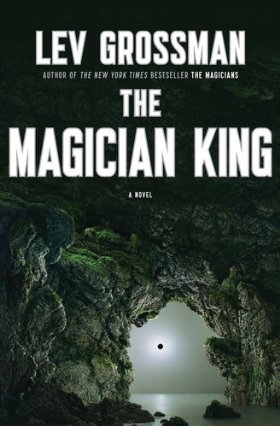
The Magician King

The Magician King, Lev Grossman, Viking, August 2011.

Today is the official release date of Lev Grossman's The Magician King, so what better day to finally get around to reviewing it? I was still undecided about The Magicians when I picked up the sequel, but after I finished The Magician King I loved them both. They aren't two books; they are two parts to a very satisfying whole.

The Magician King opens on Quentin as a jaded king of Fillory, much like the first book opened on Quentin as a jaded New York teenager. Only now he's more fashionable; he's all decked out in royal garb & the final standoff in The Magicians has left him with snow-white hair. But he's bored (What else is new, right?) & looking for adventure, which quickly finds him. A morning hunt takes a very ugly turn, leading Quentin & Julia to charter a sailing ship to fulfill an errand that takes them to the sheer edge of the world, as well as back to Chesterton, Massachusetts, where Quentin's parents live. At first Quentin's attitude is as aggravating as in book one. "I guess I'll take this awesome ship on an awesome quest. I have nothing better to do. Might as well go kill some time."  But this doesn't last long, thankfully.

What I really appreciate about this book is that Quentin & his comrades change. This didn't happen in the first book, but now, viewing them as two halves of a whole, I can see that they just needed a few extra hundred pages to grow up. Eliot & Janet soften, Quentin matures & learns to stand on his own two feet, & Julia becomes the woman she was always destined to be - which is easily the most badass thing that happens in the book.

Quentin tells half the story, but about every other chapter belongs to Julia, whose voice is angry, powerful, & compelling. We learn what she was up to while Quentin was attending Brakebills & gallivanting around Fillory in book one, & it's a gritty, urban, from-the-ground-up counterpart to Quentin's story of easy success. The dark hunger for magic, for an entry into Quentin's world, fuels Julia & comes close to destroying her. Her story really makes the book. 

The Magician King has it all: well-developed characters, beautiful description, wonderfully varied settings & circumstances, a quest. What is it about books about quests that makes them so awesome? Quentin & Julia are on a quest for the fabled seven golden keys of Fillory, with a fantastic supporting cast of characters (including a talking sloth named Abigail whom I just loved). When I was twelve, my favorite of Brian Jacques's Redwall books was Pearls of Lutra, about a quest for six pearls. My favorite Narnia book has always been The Voyage of the Dawn Treader, about a quest for the seven missing Narnian lords. & my favorite book of all time is Michael Ende's The Neverending Story - the most epic quest ever! - about a boy searching for the archetypal water of life & a way home. 

His nods to Dawn Treader & Narnia, by the way, are many, & I appreciated them very much. Some are subtle, like his use of the phrase "further up & further in" from The Last Battle, while others are more obvious. Grossman's world's end definitely calls to mind the world's end that Edmund, Lucy, Eustace, & Reepicheep discover in Dawn Treader - the pair of people, an old man & a young woman, guarding the door at the end of the world, for example. 

So okay, I'm a sucker for quests. But that also means I'm a harsh judge of quest stories, & Grossman wrote an amazing one. It's a pair of books I will reread over & over, rereadability being one of my marks of a really great fantasy. The ending of The Magician King (also a nod to C. S. Lewis's books) might frustrate some readers, but I thought it was perfect. All in all, a worthy addition to the fantasy canon.

Next up: Okay for Now by Gary Schmidt. 

Friday, July 29, 2011

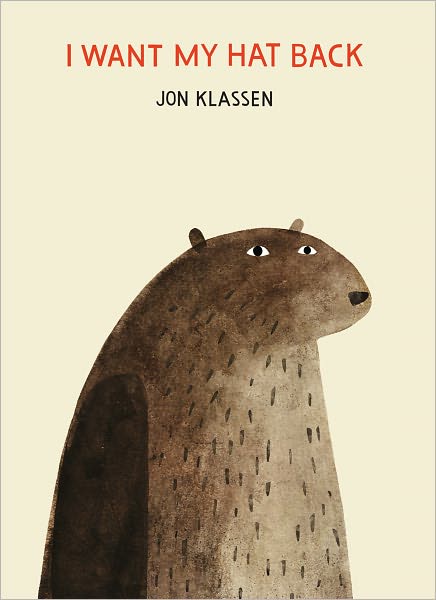
I Want My Hat Back

I Want My Hat Back, Jon Klassen, Candlewick Press, September 2011

This morning Candlewick tweeted an adorable picture of a gray bunny with a little red paper cone hat taped to his head. (I'm a bunny owner. Stuff like that kills me. Though mine would NEVER allow me to tape anything to his head, & if I somehow managed to he'd rip it off & eat it.) The picture was a hat tip to the upcoming picture book I Want My Hat Back, the debut by author/illustrator Jon Klassen, & when I saw it I realized - How have I not expressed my love for this book yet?!

When my Candlewick rep came to visit in the spring she said, "There is this new book. It's going to be huge. & it is so wonderful I want to read it to you right now." So she did. (Props to Candlewick for having such enthusiastic reps!) It was like preschool story time all over again. She read the book to me - a deceptively simple story about a bear who loses his hat & asks all his friends if they've seen it - & by the end we were both laughing hysterically. A month later at BEA, Jon Klassen was there & I was giddy as 12-year-old me at a Hanson concert to meet him & get my hands on a copy of the book. "This is the best picture book I've read in years!" I gushed. I probably embarrassed him. I gushed to so many people prior to his signing that I ended up in his line with a queue of at least 10 other people to whom I had gushed earlier that day. I am an I Want My Hat Back evangelist, much as I am an Adam Rex evangelist. (Seriously, go buy all of his picture books. You won't be sorry.)

The illustrations are as simple as the plot - soft watercolors in warm browns & black with a dash of red - but they evoke the kind of brilliant dry humor usually only reserved for BBC sitcoms. Catch a glimpse by watching the book trailer. If you don't find the trailer funny, you probably won't find the book funny. & you don't have a sense of humor. I kid.

But not really.

Told entirely in dialogue, the story just begs to be read aloud, & a child reader will be a few steps ahead of the bear in figuring out where his hat went, which makes for fun interactive reading. But, like with Adam Rex's picture books, I concede that grown-ups will get more out of this book about a very droll bear & his missing hat than a child will. I concede also that those grown-ups will need a slightly twisted sense of humor, as - SPOILER ALERT! - the sneaky rabbit who steals the hat gets his, um, just desserts in the end.

Which leads me to a very important point: Kids aren't introduced to enough twisted humor these days! Books like I Want My Hat Back are so vital. It's the quest Maurice Sendak has been on since he started writing: introduce kids to darkness early, so that they'll be able to laugh about it when they grow up. (I paraphrase.) Childhood favorites of mine included Sendak's Outside Over There (kidnapping & a freaky ice baby)Guess What? by Mem Fox (a gloriously messed-up book that you have to see to believe), & In a Dark, Dark Room by Alvin Schwartz (a little girl's head falls off!). I Want My Hat Back isn't horrific in such visual ways; it's very tame by comparison. But it is the people who are in Sendak's camp who will really appreciate the book. The ones who applaud the notion of "You think this book's too scary for kids? So? Wet your pants." (I paraphrase.)

I Want My Hat Back isn't scary, per se. But when you're reading the book with your son or daughter or doing storytime in your library, be prepared to answer the question, "What happened to the rabbit?" & don't sugar-coat it. Because it won't be funny that way.

Lastly, if my evangelism isn't enough, as Levar Burton would say, you can't take my word for it! Daniel Handler, a.k.a. Lemony Snicket, recommended I Want My Hat Back in a blog post for "Dinner: A Love Story." I too have read the book almost 50 times, & yes, it sustains.

Verdict: You need this book on your shelf to love & treasure & laugh at for years & years. I cannot wait to see what else Jon Klassen has up his sleeve.


Thursday, July 28, 2011

The Mostly True Story of Jack

The Mostly True Story of Jack, Kelly Barnhill, Little Brown, August 2011.

I went to ALA hoping to come home with a copy of The Mostly True Story of Jack after seeing it in Little Brown's summer catalog. The title & its cover grabbed me, calling to mind the story of Jack & the beanstalk while also looking like something a little out of the ordinary. The blurb is intriguing: "When Jack is sent to Hazelwood, Iowa, to live with his crazy aunt and uncle, he expects a summer of boredom. Little does he know that the people of Hazelwood have been waiting for him for a long time..." I snagged an ARC & it shot to the top of my to-read pile.

I was relieved & delighted to find that the book lived up to its lovely cover: It has elements of ages-old storytelling but feels contemporary. It is challenging, suspenseful, & compulsively readable. The characters are thoughtfully drawn, the setting well described, & the fantastical elements of the story are totally cool in an almost eerie way - a house that lives & breathes, shivers & tingles; women made of bark & corn silk; a schoolhouse with the power to collapse in on itself & regenerate.

One of the book's strongest points is the mystery Barnhill begins weaving on page one. "Frankie was the first to know. Frankie was the first to know most things - but, since he hadn't spoken since he was eight years old, it didn't matter what he knew. ... Frankie laid his left hand over the knot of scars that curled over half his face. ... It's coming, the scars said. ... No, Frankie thought, shaking his head. Not it. He. He's coming."

How did Frankie know things before anyone else? Why can't Frankie talk? What happened to him? Why is he scarred? Who is coming?! I have to read on! & so it goes until page 319.

Jack goes from a life of near-literal invisibility with his parents & brother to Hazelwood, where everyone pays him attention & everyone knows something he doesn't. The mystery, rather than unfolding throughout the story, becomes increasingly more complex as the story progresses. What a wonderful thing to encounter in a middle-grade novel! Barnhill doesn't dumb anything down for her audience; the answers to the questions she poses are not easy or obvious. She challenges her readers to think & speculate from beginning to end. I remember reading Madeleine L'Engle's A Wind in the Door when I was in elementary school & being entirely overwhelmed when Meg & Calvin shrink down to go inside Charles Wallace's body to find out what's wrong with his mitochondria. The ideas were all so much bigger than me & the references were all so much more than I could understand in third grade, but I loved it nonetheless - the complexity, the fantasy, the mystery. Not that The Mostly True Story is complex on a biological scale; the similarity is that both Barnhill & L'Engle respect their child (or adult!) readers enough to let them figure things out on their own. If you have to go look up mitochondria in the dictionary, or in Jack's case, look up references to Gog & Magog, Lyonesse, or Ys, so be it. Barnhill lays out the puzzle pieces & says "Okay, now you put it together. You're smart enough."     

I honestly can give this book my personal highest children's book compliment: The Mostly True Story feels like a new classic, a modern fairy tale. Except for a mention of computers toward the very end of the book, the story's events could unfold at any time. When there is nothing to date a story, it becomes timeless. I love this quality in children's books, a quality that is becoming increasingly rare. The last time I recall having this reaction to a book - a story that blends new & old with the result being something original & timeless - was with Grace Lin's wondrous When the Mountain Meets the Moon. (My review of that one here.)

I will happily give The Mostly True Story of Jack a place on my bookshelf & most definitely will reread it at some point in the future. It's the kind of book that almost needs a reread or two to be fully appreciated. I heartily recommend it, & already look forward to Barnhill's next children's book. In the meantime, check out her blog, because it's great. (I too have loved Labyrinth since I was a child, & I too was both scarred & fascinated by David Bowie's tight pants.)  

Next up: The Magician King by Lev Grossman (...if I can find my copy! Ack! Where did it go?!)       


Tuesday, July 19, 2011

Ashes

Ashes, Ilsa Bick, Egmont USA, September 2011.

So I lied. This isn't the book I said I'd be reviewing next, but I recently finished this one & it's fresh in my mind & it's full of BLOOD & GUTS!

I was not expecting to enjoy Ashes. I love dystopian literature, but one has to be wary when there's so much of it hitting the market. All these one-name dystopian romance/thrillers are starting to run together, am I right? Matched, Crossed, Divergent, Uglies, Ashes, Delirium, etc. But this one was getting considerable buzz, & in the name of my job, I decided to read it. The synopsis didn't grab me: "An electromagnetic pulse flashes across the sky, destroying every electronic device, wiping out every computerized system, and killing billions" (Amazon).

I plodded through the first 50 pages or so, which follows Alex, a bitter teenage girl with a brain tumor, on a trek through the woods to fulfill a personal mission. She comes across Ellie, an 8-year-old girl, & Ellie's grandfather, & then BOOM! EMP! Grandfather drops dead. Not knowing what happened or the extent of the damage, Alex continues on her way. Soon, she has Ellie and young army vet Tom in tow, & the group finds itself just struggling to survive. The EMP has killed most adults. The very old & very young have survived, & teens are turning into the Changed.

I wasn't hooked until the moment Alex & Ellie come to a clearing in the woods. Amongst the trees, two teens crouch over a dead body, which they are dismembering & eating. & it's GROSS. Entrails & innards & blood & guts & the girl even pokes a finger into the dead person's eyeball & eats it like a lollipop.

Okay, Ms. Bick, you have my attention.

From then on it's like watching an awesome, gory zombie movie with slightly more depth, & I mean that as a sincere compliment. (Though to be fair they aren't really zombies in the traditional sense, more like people transformed into crazed cannibals.) Bick is brilliant with disturbing imagery. Before long I felt genuinely invested in this little band on their quest for survival, much like I rooted for Shaun & his buddies on their way to the Winchester, & Jim & co. as they moved through desolate England trying to avoid those infected with the Rage.

Like most contemporary zombie movies, Bick doesn't do anything particularly new or different. For the most part, the components of Ashes, from the restructuring of society in isolated factions to Alex taking out the Changed like a badass, already have been depicted on screen or paper. & like most contemporary YA novels, a love triangle arises & Alex finds herself torn between boy loyalties.

Does that make it any less fun? No. It's fun as hell. I devoured the book like the Changed devour their prey, gooey intestines & all.

My main criticism of the book is that it is rather overwritten. Bick's action scenes flow well, but her description is so wordy it can get exhausting. Metaphor really gets away from her. I noted the words "bloom," "squall," & "dazzle," which appear so many times in the novel I lost count. "Bloom" as in "the blood bloomed on his shirt," & "squall" like "the floorboard squalled under her foot." The light always "dazzles." You should never think while reading a novel, "Boy, I feel like I've seen this word a hundred times," especially when it's an unconventional word use like the verb "squall." Also, the ash theme is very heavy-handed. Ashes are everywhere; everything looks ashy. It could've been tamped down quite a lot & still been effective.

But that's the editor in me talking. & that's a complaint I bet won't register with 95% of the people who read this book. What's more, I predict that 95% will love the book wholeheartedly, because it's good, clean, gory fun. Not only will I pick up the sequel as soon as I am able, but I will likely reread "Ashes," in the same way that it's always fun to rewatch "Night of the Living Dead."

I hated Twilight. I enjoyed the Hunger Games & Uglies but haven't felt compelled to pick up the sequels. But something about Ashes puts it a few cuts above. It might be the gore, which I do so love. It might be that Alex is a strong, believable protagonist. Even when she reflects on her attraction to the guys in the book, it is always framed in the context of survival. In essence, she is a teenage girl - & all teenage girls get crushes - but she has more important things on her plate. 

Verdict: Pick this one up when it hits bookstores in September! & in the meantime, check out Ilsa Bick's blog. Good stuff.

& just as an aside, my boyfriend sees all the books I bring home & dubs a lot of them derivative crap just by glancing at the cover. He's disliked most of the trendy YA he's read, but he picked this one up & blew through it in a few days just like I did. I'm tellin' you, it's addictive stuff.

Next up: The Mostly True Story of Jack by Kelly Barnhill.